What Is a Keepsake? Meaning, Examples and How to Choose One
A keepsake is an object you keep because of the person or moment it reminds you of. It is usually a gift, it is often small, and its value comes from the memory attached to it, not from the price tag. A baby’s first Christmas bauble, a handwritten note in a bottle, a locket from a grandmother: all keepsakes. If you are choosing one for someone, our keepsake gifts are made to carry a name or a message of your own, which is what turns an ordinary present into one that gets kept.
TL;DR
- A keepsake is something kept, or given to be kept, to remember a person, event or relationship.
- It differs from a souvenir: a souvenir marks a place you visited, a keepsake marks a person or a moment you value.
- Keepsakes can be cheap or expensive, tiny or large. The meaning is what counts.
- Personalising a gift, with a name, date or your own words, makes recipients more likely to appreciate and hold on to it, according to a 2024 study.
- Good occasions for keepsakes include births, weddings, anniversaries, retirements, thank-yous and Christmas.
Table of Contents
- What does keepsake mean?
- Keepsake meaning in everyday use
- Keepsake or souvenir: what is the difference?
- What makes something a keepsake worth keeping?
- Keepsake ideas by occasion
- How to choose a keepsake gift
- Keepsakes at Giftdelivery
- Why keepsakes matter
- FAQ
- Sources
What does keepsake mean?
The Cambridge Dictionary gives the British English definition as a small present, usually not expensive, given to you so that you will remember the person who gave it. Collins widens it slightly: a gift that evokes memories of a person or event it is associated with.
Put together, three ideas sit inside the word:
- It is kept. You do not use a keepsake up. It stays in a drawer, on a shelf, in a box or on your wall.
- It is tied to someone or something. The object matters because of what it stands for.
- It is often given. Most keepsakes arrive as presents, though you can also keep something yourself, such as a ticket stub or a child’s drawing.
Dictionary.com describes a keepsake as an object with sentimental value, kept for the sake of the people and events we want to remember, and gives a grandmother’s locket or a child’s drawing as examples. Nobody would call either of those valuable in the shop-window sense, and nobody would throw them away.
Where the word comes from
It is a tidy bit of English. Etymonline traces “keepsake” to around 1790, formed on the model of “namesake”: something kept for the sake of the giver. By the 1830s the word had also come to name popular annual gift books of engravings and poetry, sold as Christmas presents. So the link between keepsakes and gift-giving at Christmas is more than two centuries old.
Keepsake meaning in everyday use
In conversation, people use the word in a few slightly different ways.
- As a thing you were given. “This watch was a keepsake from my dad.”
- As a thing you made or chose to remember something. “We bought a little keepsake from our first flat.”
- As an adjective for a type of gift. “A keepsake box”, “a keepsake card”, “a keepsake heart”.
The phrase “keepsake gift” is simply a present chosen so that it will be kept. Collins lists souvenir, token, reminder, memento and remembrance among its synonyms, though they are not perfect swaps, as the next section shows.
Keepsake or souvenir: what is the difference?
The two overlap, and dictionaries list each as a synonym of the other. In practice the difference is about what the object points back to.
| Keepsake | Souvenir | |
|---|---|---|
| Reminds you of | A person, relationship or milestone | A place or trip |
| Typically comes from | Someone who cares about you, or your own choice | A shop at the destination |
| Usually | Personal, sometimes made to order | Mass-produced |
| Typical examples | Locket, engraved gift, handwritten letter, baby’s first bauble | Fridge magnet, postcard, snow globe |
Collins defines a souvenir as an object that reminds you of a certain place, occasion or person, so a souvenir can be a keepsake if it carries real meaning. The reverse is less true. A keepsake does not need a place at all. If the object only says “I was in Blackpool”, it is a souvenir. If it says “this is what we were to each other”, it is a keepsake.
What makes something a keepsake worth keeping?
Most people have a drawer of things they were given and never looked at again. What separates those from the objects people hold on to for decades?
It says something specific
A generic mug is a mug. A mug that carries an in-joke, a name or a date is a reminder of one particular relationship. That specificity is what keepsakes are made of.
The giver’s effort shows
Research supports this. A 2024 study by Pizzetti, Acuti, Soscia and Gibbert in Psychology & Marketing, which included a UK sample of 225 participants, found that recipients of customised gifts felt more vicarious pride and appreciated the gift more than recipients of non-customised gifts (appreciation scores of 5.36 against 5.00 on the study’s scale). Vicarious pride here means the recipient mirrors the giver’s satisfaction in having chosen well.
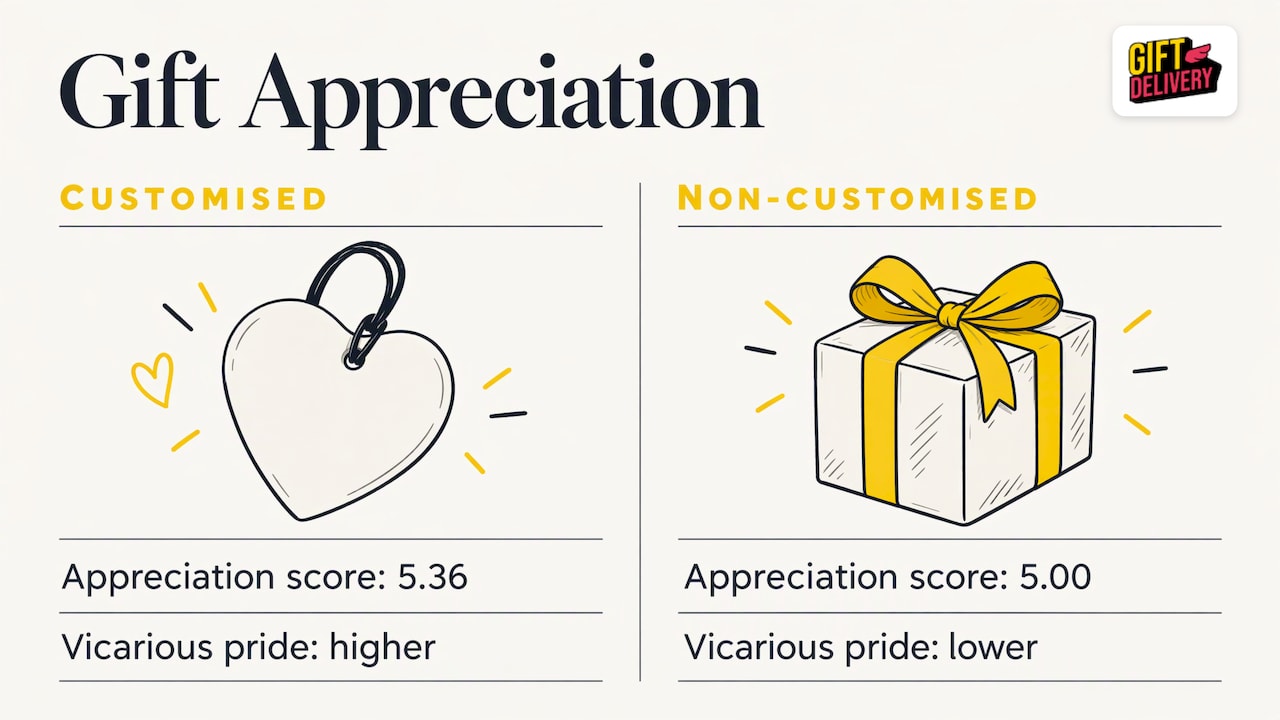
The Conversation’s write-up of the same University of Bath-led research adds a practical finding: receivers of personalised gifts were more likely to care for, repair and keep the item, which extends its life. In other words, personalising is not just a nice touch. It is the thing that moves a present from “used and forgotten” towards “kept”.
The researchers also recommend that givers let the recipient know about the customisation, so a short line explaining why you chose that wording or that date is worth adding to the card.
It will last
A keepsake needs to survive being put in a box. Think about whether it can be stored flat, whether it will fade, and whether it will still make sense in ten years. Something that depends on a trend or a season may be fun, but it is a different kind of present.
It has a story
The best keepsakes come with a sentence or two of context. Why this gift, why now, what it reminds you of. That note often becomes part of the keepsake itself, and it is the part people reread.
Keepsake ideas by occasion
Here is how the idea plays out across the moments people most often mark.
Babies and first Christmases
New parents tend to keep everything, so a keepsake with a name and a year on it fits naturally. A dated bauble or a small boxed gift will come out each December for decades. Our guide to baby’s first Christmas keepsakes goes through ideas for new parents.
Weddings and anniversaries
Couples keep objects that hold their own words or names: a printed vow, a framed line from a song, a dated gift. If you are choosing for a couple, see our ideas for personalised wedding presents. For anniversaries, a message that refers to something only the two of you know will always beat a generic card.
Retirements and milestones
A retirement or a promotion is a point where colleagues and family want to say “we noticed what you did”. A keepsake suits that better than a consumable gift, because it stays on a desk or shelf long after the leaving drinks. Browse retirement gift ideas or our pieces on congratulations keepsake gifts for more.
Staying in touch from a distance
When you cannot be together at Christmas, a keepsake carries something of you into the room. Our guide to keepsake gifts for Christmas apart covers ways to stay connected.
Remembering someone
Keepsakes are also how people hold on to those they have lost, whether a person or a pet. A short, plain message works better than anything elaborate. We have written about the comfort of keepsake gifts after pet loss and about “thinking of you” Christmas keepsakes.
Thank-yous and grandparents
A teacher, a neighbour, a nurse: a thank-you with a few honest words on it is a keepsake in its own right. For grandparents, a message written in a grandchild’s own words is hard to beat, and there is an idea for that in our grandparent gift in a grandchild’s own words.
How to choose a keepsake gift
A short routine helps, and it takes about five minutes.
- Start with the person, not the product. What do they already keep? Photos, jewellery, cards, books? Match the form to the habit.
- Pick the one thing you want it to say. A name, a date, a sentence. One clear message is stronger than three.
- Write the words before you order. Read them aloud. If they sound like a greetings-card cliché, make them more specific: a nickname, a shared joke, a place.
- Check the size and the shelf. Will it fit in a drawer, on a mantelpiece, in a memory box?
- Add a line of context. Tell them why you chose it. That small note is what the studies point to: when recipients know the effort behind a gift, they value it more.
- Allow time for delivery. Personalised items are made for you, so order early in busy periods such as the run-up to Christmas.
A note on humour
A keepsake does not have to be solemn. Some of the most-kept gifts are the ones that make someone laugh every time they see them: an in-joke on a mug, a ridiculous Christmas jumper that the family wears every year and photographs. Humour is a perfectly good way to say “I know you”. If that is your family’s style, our funny Christmas jumpers are a good place to start.
Keepsakes at Giftdelivery
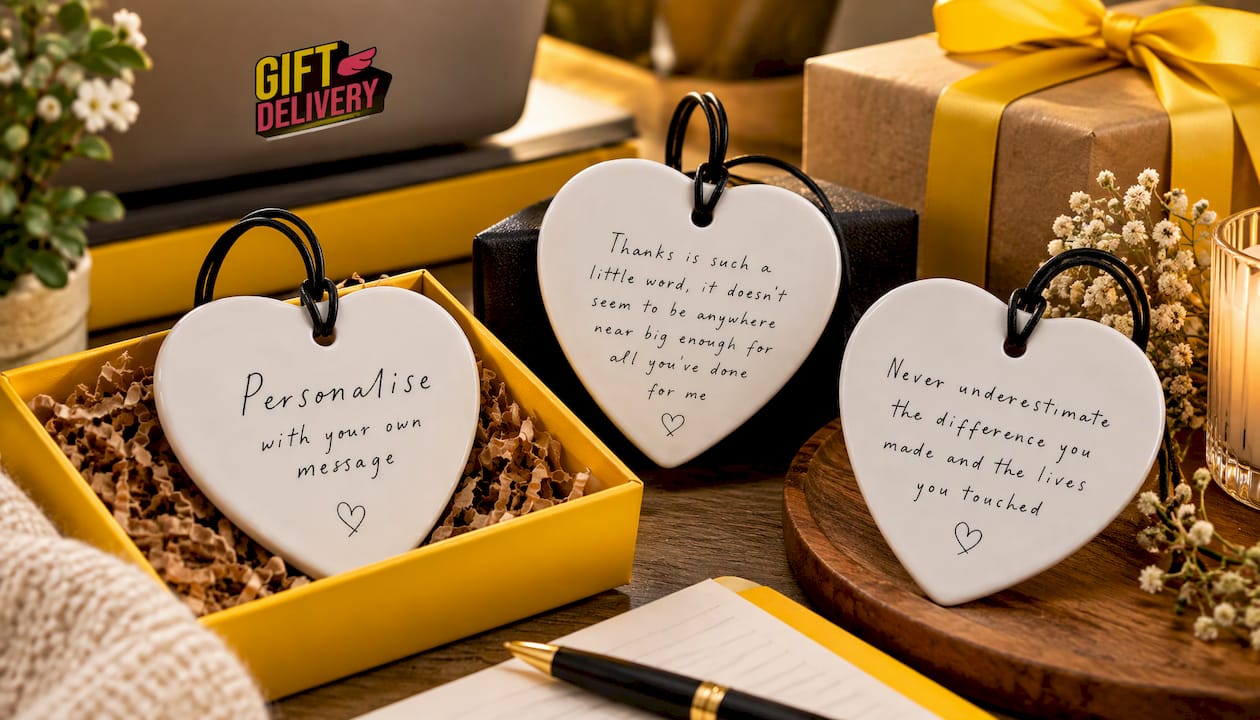
We sell keepsakes, message-in-a-bottle gifts, greeting cards, mugs, Christmas decorations and letterbox gifts, with designs you can personalise with names or messages. A good place to begin is the Personalised Keepsake Heart with Your Own Message, where the words are yours. If you would rather say thank you, there are also the Thanks Is Such a Little Word keepsake heart and the Never Underestimate the Difference You Made keepsake heart.
For a gift that is meant to be opened and read, take a look at our message in a bottle gifts, and for something that fits through the door, our letterbox gifts. Pair either with one of our greeting cards and write the note explaining why you chose it.
Why keepsakes matter
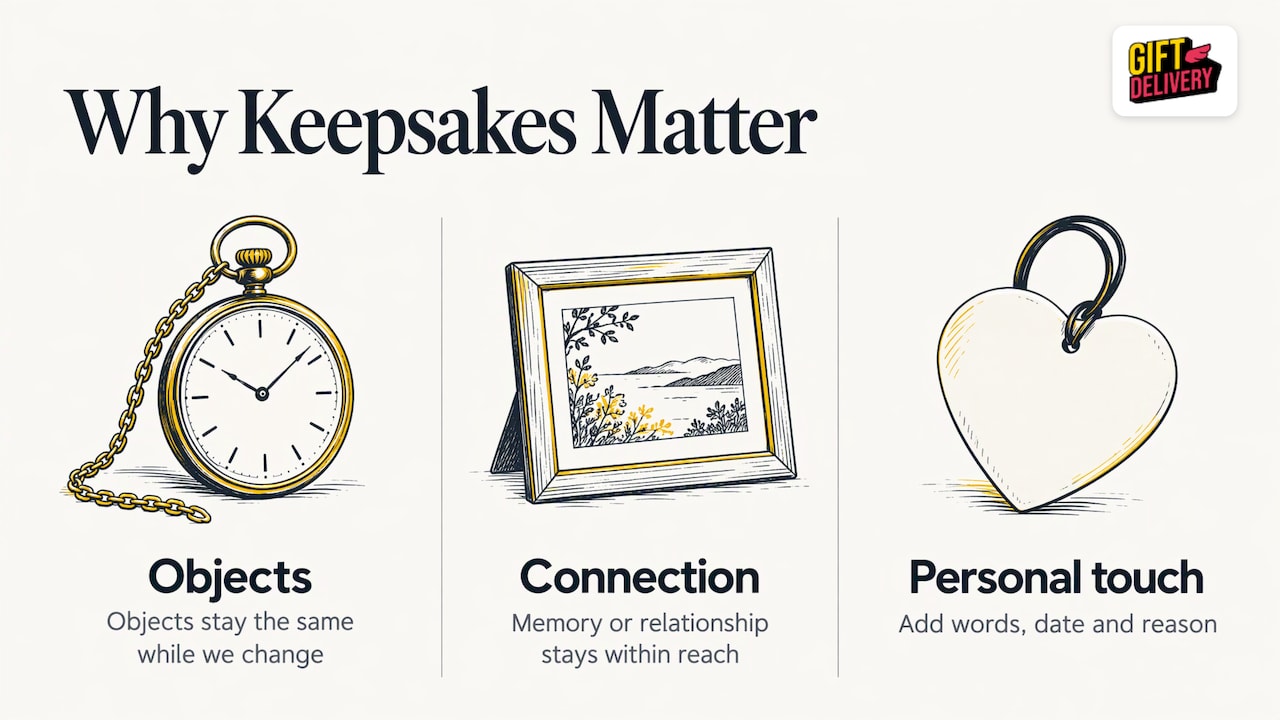
The Legacy Project, a family-storytelling resource, makes the point that objects stay the same while we change, which is why we hold on to certain ones. Whether or not you think of it that way, the instinct is familiar. Years from now, nobody remembers the price of the present. They remember who gave it and what it said.
That is the answer to “what is a keepsake” in practical terms: it is any object that lets a memory or a relationship stay within reach. You can buy one in minutes, but the part that makes it a keepsake, the words, the date and the reason, is the part you add.
FAQ
What does the term “keepsake gift” mean?
A keepsake gift is a present chosen to be kept, not used up, because it reminds the recipient of the giver or of a special event. Cambridge describes it as a small present given so that you will remember the giver. It is often personalised with a name, date or message.
What is a synonym for keepsake?
The closest synonyms are souvenir, token, memento, remembrance and reminder, all of which appear in Collins’ list of synonyms. Memento and remembrance suit personal and emotional objects best. Souvenir leans towards travel.
Does a keepsake have to be expensive?
No. Dictionaries describe a keepsake as a small present that is usually not expensive. What matters is the personal meaning. A short handwritten message or a dated ornament can be kept for far longer than a costly but anonymous gift.
What are some keepsake ideas?
Common choices include personalised hearts, message-in-a-bottle gifts, engraved items, framed words, cards, dated Christmas baubles and mugs with a private joke. The right one depends on the occasion: a baby’s first Christmas, a wedding, a retirement or a thank-you each call for a different tone.
Sources
- KEEPSAKE | English meaning, Cambridge Dictionary
- KEEPSAKE definition and meaning, Collins English Dictionary
- KEEPSAKE Synonyms, Collins English Thesaurus
- Synonyms of SOUVENIR, Collins Thesaurus
- KEEPSAKE Definition and Meaning, Dictionary.com
- Keepsake, Etymology, Origin and Meaning, Etymonline
- You designed that yourself for me? Vicarious pride in customised gifts, Psychology & Marketing (2024)
- Personalised gifts really do mean that little bit more to your loved ones, The Conversation (2024)