
Christmas Card Ideas: Personal, Funny and Unique Designs
The best Christmas card ideas start with the person receiving the card, not the design. A joke that suits your brother will fall flat with your nan, and a photo card that delights grandparents is wasted on the office. Match the card to the recipient, add one detail only they would get (a name, a shared memory, an in-joke) and the card stops being a standard festive design. Our greeting cards are built around exactly that: humour and personal touches for different people and occasions.
Below you will find ideas sorted by recipient, ways to make a card feel unique, handmade options for every skill level, what to write inside and a few practical posting notes.
TL;DR
- Choose the card by recipient: funny for friends, siblings and colleagues, sentimental for grandparents and partners, simple and warm for neighbours.
- One personal detail (a name, a nickname, a memory, a photo) does more than any amount of glitter.
- Pair a card with a small keepsake, a mug or a jumper and the card becomes part of the gift.
- Handmade cards can take five minutes, and the easy techniques cost under £3.
- Write two or three honest lines rather than a long message, and check the posting dates for the year before you send.
Table of Contents
- Card ideas by recipient
- What makes a Christmas card feel unique
- Card and gift combinations that work
- Handmade Christmas card ideas
- Funny Christmas card ideas that land
- What to write inside a Christmas card
- Christmas card trends worth knowing
- Our pick: personalised cards and keepsakes
- Posting your cards on time
- FAQ
- Sources
Card ideas by recipient
A card list works best when you sort it by people. Most households send to five or six groups, and each wants something slightly different.
Friends and siblings: make them laugh
Humour is the safest bet for people who know you well. Puns, pop-culture nods and gentle teasing all work, as long as the joke is one the recipient would repeat. Think of the card that gets propped on the mantelpiece rather than the one that goes in the recycling in January.
If you want a proper steer on wording, our guide to what to write in a funny Christmas card has messages for friends, family and colleagues.
A funny card also pairs well with a funny jumper. If you are sending a card to someone who loves a festive knit, our funny Christmas jumpers give you a gift and a card with the same sense of humour. Football fans can find their club on our football Christmas jumpers page.
Colleagues: light, kind and never risky
Office cards need a lighter touch. A mild pun, a team in-joke or a simple thank-you for the year works. Avoid anything you would not say in front of your manager. If the office has a jumper day, a card that nods to it keeps things cheerful. We have a page on funny Christmas jumpers for the office party if you are planning one.
Grandparents: sentimental wins
Grandparents tend to keep cards. A family photo, a child’s drawing or a message in a grandchild’s own words will be read again and again. If you want to go further than a card, see our personalised grandparent gift using a grandchild’s own words.
The idea of attaching a favourite family photograph to a card, then adding a short message, the names of everyone in the photo and the year, is a simple way to turn a card into a keepsake. Writing the year on it matters more than people expect: in ten years that line is what makes the card precious.
Partners: one line that only you two understand
For a partner, skip the generic verse. Refer to something that happened this year: the holiday, the disastrous bake, the first flat. A personalised card with a name and a short message of your own beats any printed poem. If you want something to sit beside it, a personalised keepsake heart with your own message lets you put those words on something they can keep.
New parents and first Christmases
A baby’s first Christmas deserves a card with a date on it, and most parents keep these in a memory box. Pair the card with something lasting: our baby’s first Christmas keepsake ideas for new parents will give you a few starting points.
People you cannot see this year
For distance, illness or a difficult year, the card carries more weight. Keep the message short and sincere, and say specifically that you are thinking of them. If you are apart, our ideas for keeping in touch with keepsake gifts may help. For remembering someone who has died, our page on thinking-of-you Christmas keepsakes offers gentle options.
What makes a Christmas card feel unique
A card feels unique when it could only have been sent to one person. Standard designs (robin, snowman, gold foil) are lovely, but they are interchangeable. These changes make the difference:
- Use their name or nickname. A card addressed to “Dad” is nice. A card with the nickname only you use is memorable.
- Refer to a shared memory. One sentence about a moment from the year is enough.
- Pick a theme from their interests. Football, pets, gardening, a TV series they quote constantly. Pop-culture humour works because it says you know what they like.
- Add something to open or keep. A card that carries a small gift, or a gift that carries a card, gets kept longer.
- Change the format. A message in a bottle is a different experience from a flat card. Our message in a bottle gifts let you personalise a note that arrives rolled up inside. The personalised message in a bottle with a Christmas tree charm is a festive version.
The point is not extravagance. A plain card with a specific, funny or tender line beats an expensive one with nothing personal in it.
Card and gift combinations that work
A card on its own is a gesture. A card with a small gift is a present. Here are combinations that suit most budgets and need no big planning:
| Recipient | Card style | Pair it with |
|---|---|---|
| Best friend | Funny, in-joke | A funny Christmas mug |
| Sibling | Pop-culture or teasing | A funny Christmas jumper |
| Grandparents | Photo or family message | A personalised keepsake |
| Partner | Handwritten, personal | A keepsake heart with your message |
| Colleague | Light pun | A small bauble or a mug |
| New parents | Dated, warm | A baby’s first Christmas keepsake |
If you are wrapping a mug with a card, we have a short guide on how to wrap a Christmas mug in three simple ways. Small flat items also suit our letterbox gifts, useful when the recipient lives far away.
Handmade Christmas card ideas
A handmade card says you spent time on it. It is also a good family activity. If you want to make some cards yourself, there are options for every skill level, and many take minutes.
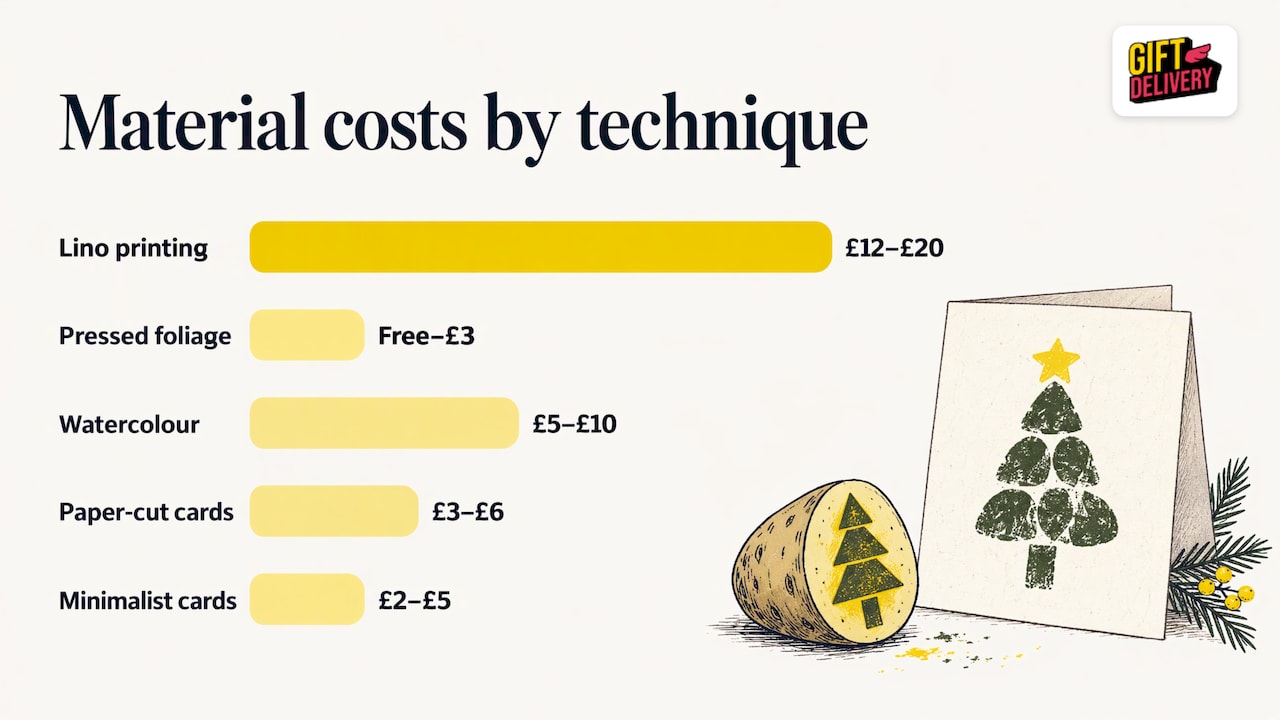
A technique guide from ChristmasCountdown, updated in June 2026, rates potato and foam block printing as the easiest option: about five minutes per card and under £3 for a set, with a potato block giving roughly 15 to 20 good prints before it softens. The same guide lists:
- Lino printing: moderate difficulty, £12 to £20 for tools that last, suitable for ages 9 and over with supervision.
- Pressed foliage and botanical prints: easy, free to £3.
- Watercolour: easy to moderate, with a £5 to £10 paint set.
- Paper-cut and aperture cards: moderate, £3 to £6, ages 10 and over.
- Salt-dough stamped charms: easy, under £2.
- Minimalist one-motif cards: easy, £2 to £5.
For something quirky, Good Housekeeping suggests felt designs, where a mistletoe sprig, a tree or a Christmas jumper cut from felt becomes the focal point, with string or felt balls adding detail.
Tips for handmade cards that look good
- Make a batch of the same design, then personalise each one with a different message. It is quicker and looks consistent.
- Keep to one motif and two colours. Cluttered cards look amateur; simple ones look deliberate.
- Write the message first, then decorate around it so you do not run out of space.
- Let the children do the printing, then you add the words.
If you want the personal feel without the crafting, our greeting cards take care of the design, so you can spend your time on the message.
Funny Christmas card ideas that land
Funny cards divide into a few types, and knowing which one suits your recipient saves you from a groan at the wrong moment.
- Puns. Safe, universal and easy to get right. Best for colleagues, neighbours and extended family.
- Teasing. Works for siblings and close friends. The joke should be about something they would laugh at themselves.
- Pop-culture references. A film, a TV show or a meme from the year. These work because they show shared taste, and they are the most likely to be talked about.
- Self-deprecating. A joke about yourself (the diet, the overbooked diary) is never offensive.
- Pet cards. Cards “from the dog” or “from the cat” rarely fail.
A good rule: if you would hesitate to say the joke out loud to that person, do not write it on a card.
What to write inside a Christmas card
The blank space inside a card scares people more than the design. The fix is to keep it short and specific.
A simple three-part formula:
- A greeting (“Merry Christmas, Sam”).
- One specific line (“Still laughing about the barbecue disaster”).
- A wish for the year ahead (“Here’s to seeing more of you in the new year”).
Ways to wish someone Merry Christmas without repeating yourself:
- “Wishing you a Christmas full of good food and nobody asking about your plans.”
- “Hope your Christmas is warm, loud and has plenty of cake.”
- “Thinking of you this Christmas, and looking forward to next year.”
- “Happy Christmas from all of us, including the dog.”
For grandparents, add the names of everyone in the family. For colleagues, a brief thank-you for something specific from the year is better than a generic wish. For a partner, say the thing you do not say often enough. If you want more wording ideas, our guide to what to write in a funny Christmas card has plenty.
Christmas card trends worth knowing
Styles change a little each year, but a few directions keep returning in UK cards: personalised and name-led designs, humour and pop-culture references, and cards that double as a keepsake. Rather than chase trends, pick the one that fits the person. A card chosen for the recipient never goes out of date.
Our pick: personalised cards and keepsakes
If you want a card that is personal without the effort of making it, start with our greeting cards. The shop brings together humorous, pop-culture-inspired gifts and personalised keepsakes, cards and clothing for different occasions, and you can add names or messages to designs that allow it. Many people choose a card, then add a mug, a jumper or a keepsake from the Christmas gifts range, so the whole gift arrives from one place.
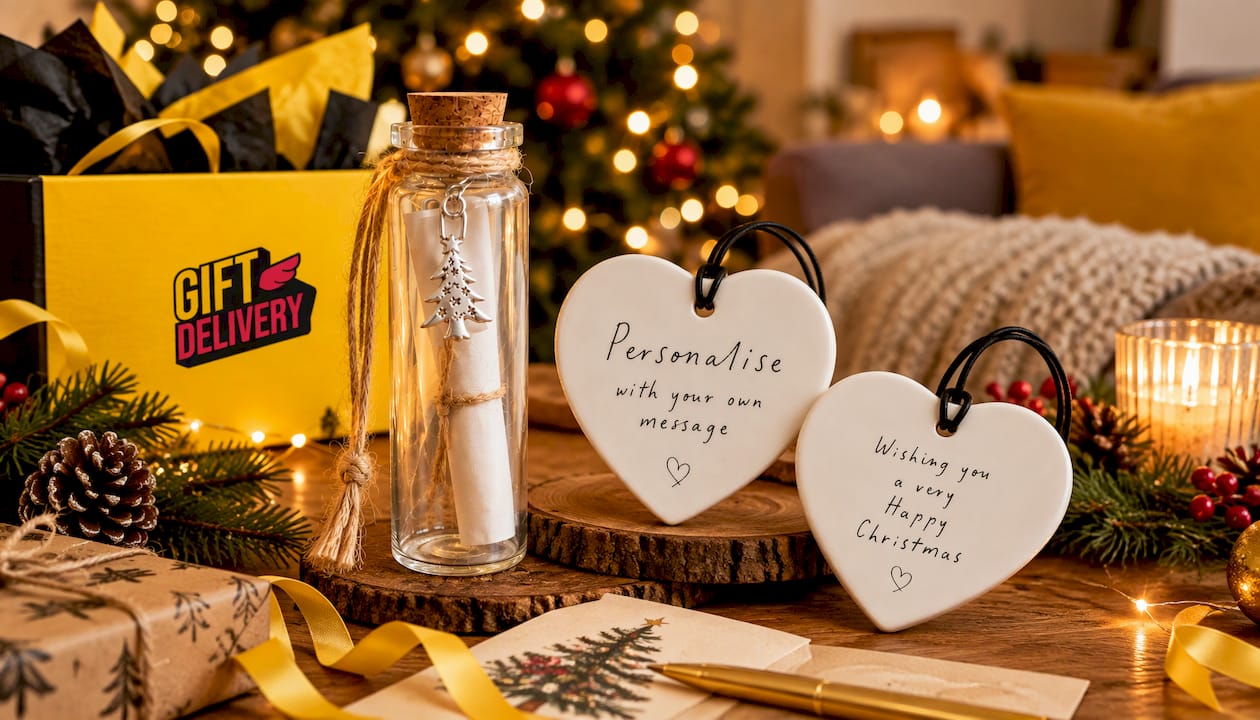
If you would rather give something that lasts longer than the card, browse our keepsakes or the full shop at Giftdelivery.
Posting your cards on time
Post your cards early. Royal Mail publishes last Christmas posting dates every year, with separate deadlines for second class, first class and tracked services. Second class has the earliest cut-off, so if you are sending a card with a gift, or to a relative far away, post a week or more before the final date. Check the page for the current year’s dates, because they change annually.
A simple plan helps:
- Make a list of recipients in early November.
- Choose a card for each group.
- Write the messages in one sitting.
- Address and stamp the envelopes before you post.
FAQ
What are good Christmas card ideas for people who have everything?
Send a card with a personal touch rather than something bought for show: a name, a shared memory and a handwritten line. A small keepsake such as a message in a bottle also works well because it is about the sentiment, not the item.
How do I make a Christmas card more personal?
Use the recipient’s name or nickname, mention one specific memory from the year and sign with something only you would write. For family, add a photo and the year so the card becomes a keepsake.
What can I write in a Christmas card if I do not know what to say?
Use three short parts: a greeting, one specific line about them and a wish for the year ahead. Keep it to two or three sentences. Honest and brief always reads better than long and generic.
What are easy handmade Christmas cards?
Block printing with a potato or foam shape is the easiest, taking around five minutes a card and costing under £3 for a set, according to ChristmasCountdown’s technique guide. Pressed leaves and minimalist one-motif cards are also quick.
Sources
- Christmas Card Ideas to Make at Home (By Technique), ChristmasCountdown
- 55 homemade Christmas card ideas to DIY for your loved ones, Good Housekeeping UK
- Last Christmas posting dates, Royal Mail